

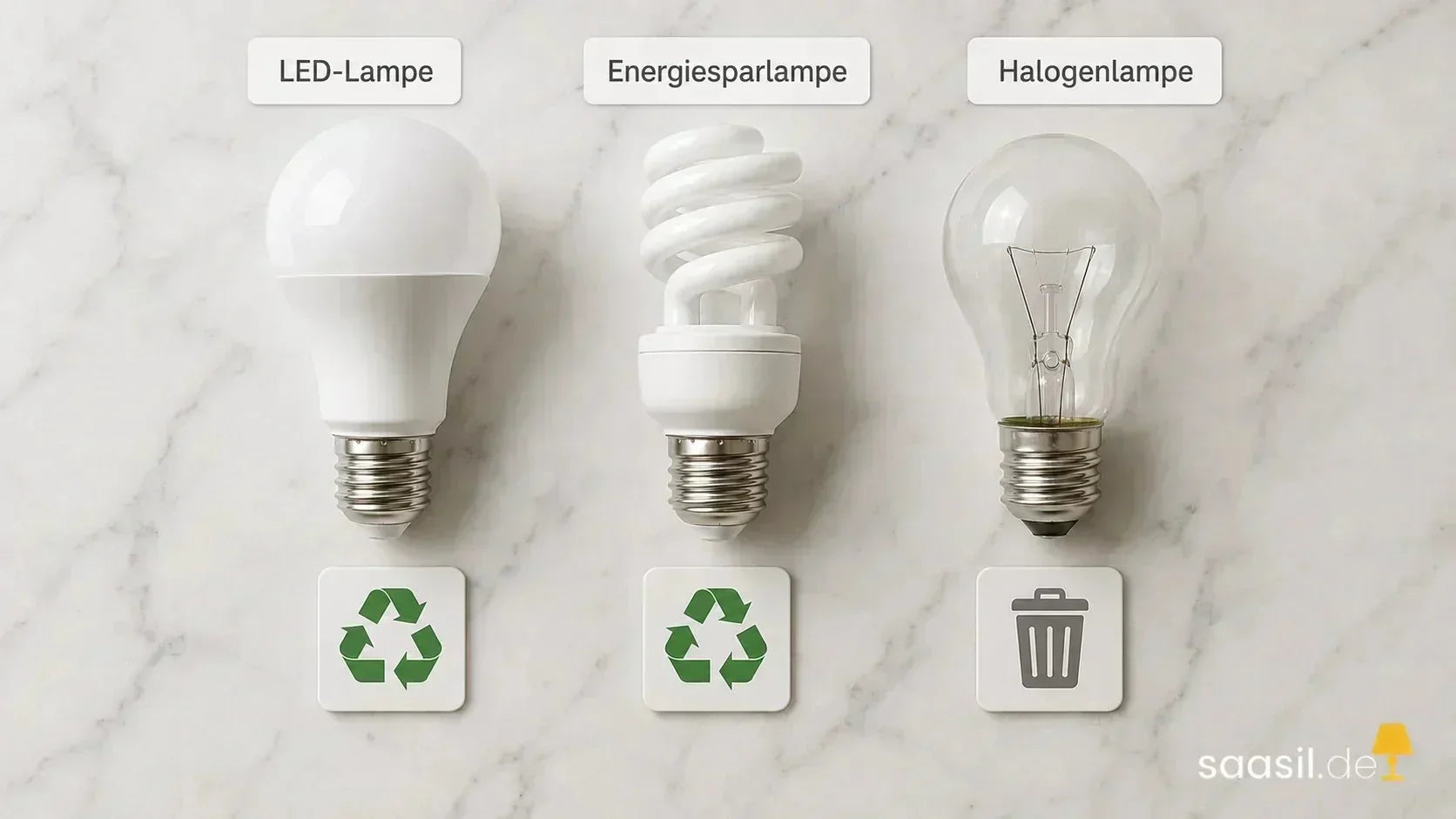
Old light sources do not automatically belong in the residual waste. The decisive factor is the technology inside the lamp: conventional incandescent bulbs and halogen bulbs may be disposed of via residual waste. LED lamps, compact fluorescent lamps, fluorescent tubes, and other gas discharge lamps, on the other hand, must be collected separately and handed in at a suitable collection or take-back point.
Lamp, light source or luminaire – what is meant?
In everyday life, these terms are often used interchangeably. Technically, however, there is a difference: The lamp or light source is the actual light source. This includes, for example, an E27 LED lamp, a halogen lamp, or a fluorescent tube.
The luminaire is the complete lighting device – for example, a table lamp, pendant lamp, or ceiling lamp with a housing, socket, and possibly permanently installed LED technology. This distinction is important because individual light sources and complete luminaires can be disposed of differently.
Which light sources can go in the residual waste?
Conventional incandescent bulbs can be disposed of via residual waste in Germany. They do not fall under the separate collection for waste electrical equipment.
The same applies to classic halogen bulbs. They also work with a filament and can be put in the residual waste. You should pack broken incandescent or halogen bulbs in such a way that no one can get hurt by the glass shards.
Important: Despite their glass bulb, incandescent and halogen lamps do not belong in the glass recycling container. Their glass and other components are not intended for packaging glass recycling.
Which light sources must be collected separately?
LED lamps, compact fluorescent lamps, fluorescent tubes, and other gas discharge lamps do not belong in the household or residual waste. They must also not be disposed of via the yellow bin, yellow bag, or glass recycling container.
LED lamps: These include classic LED retrofit lamps in incandescent bulb shape as well as LED spots, LED tubes, and other replaceable LED light sources. LEDs do not contain mercury, but they still fall under the Electrical and Electronic Equipment Act and must be collected separately.
Compact fluorescent lamps: These lamps are colloquially often referred to as energy-saving lamps. They contain small amounts of mercury and must be taken to a suitable collection point carefully and as break-proof as possible.
Fluorescent tubes: Rod-shaped, ring-shaped, and other fluorescent lamps must also not be disposed of in residual waste. As they may contain mercury, they should not be broken during transport.
Other gas discharge lamps: These include, for example, certain sodium vapor, metal vapor, and metal halide lamps. These lamps must also be collected separately.
Where can I hand in old LED lamps and fluorescent lamps?
The most reliable point of contact for private households is the local recycling center or civic amenity site. LED lamps, compact fluorescent lamps, fluorescent tubes, and other corresponding old lamps can generally be handed in there free of charge.
Depending on the city or municipality, there may also be a mobile hazardous waste collection service. Since these offers, acceptance conditions, and opening hours vary regionally, you should check with your municipality or the responsible waste disposal authority before driving there.
Many larger electronics stores, hardware stores, supermarkets, and other obligated or voluntarily participating retailers also take back old lamps free of charge. Whether a specific branch accepts your light source is best asked directly to the retailer.
Please do not send old light sources to SAASIL by post without being asked. Use a suitable municipal or legally provided take-back point.
Can light sources go in the glass recycling container?
No – light sources generally do not belong in the glass recycling container. This applies to LED lamps, compact fluorescent lamps, and fluorescent tubes, as well as classic incandescent and halogen bulbs.
The glass recycling container is intended for packaging glass such as bottles and jam jars. In addition to glass, light sources consist of metal, plastic, electronic components, or other materials. They therefore require a different disposal route.
What to do if an energy-saving lamp breaks?
By "energy-saving lamp," we refer to a classic compact fluorescent lamp. It contains a small amount of mercury. If such a lamp breaks, there is no reason to panic – however, you should still follow some precautions.
1. Ventilate the room immediately: Open the window and have people and pets leave the room for about 15 minutes. Switch off heating or air conditioning if possible.
2. Do not vacuum immediately: For the initial cleaning, do not use a vacuum cleaner, broom, or hand brush. This could spread contaminated dust and tiny particles into the room air.
3. Pick up fragments carefully: Wear rubber gloves. You can carefully push larger pieces together with cardboard or stiff paper. For small shards and dust, adhesive tape is suitable.
4. Seal residues safely: Place fragments, used paper towels, and adhesive tape into an airtight sealable container, such as a suitable screw-top jar.
5. Bring to the collection point: The sealed container does not belong in the household waste. Hand it in at a suitable local collection point and continue to ventilate the room during and after cleaning.
What applies to permanently installed LEDs?
Many modern luminaires have a permanently integrated LED module that cannot be unscrewed like an E27 or GU10 lamp. If the LED module cannot be removed without damaging the luminaire, the complete luminaire must be handed in as waste electrical equipment.
Do not try to forcibly break out a permanently installed LED module. The entire luminaire belongs at a suitable collection point for waste electrical equipment.
If, on the other hand, a light source can be removed without destruction, for example, a replaceable E27, E14, or GU10 LED lamp, it should be removed before handing in the old luminaire and placed separately in the corresponding lamp collection.
Why is proper disposal important?
Separate collection ensures that hazardous substances can be treated in a controlled manner and valuable materials can be recovered. Fluorescent lamps and other gas discharge lamps can contain mercury. Although LED lamps are mercury-free, they contain electronic components and recyclable raw materials.
Proper disposal therefore not only protects the environment and health, but also supports the recovery of materials and reduces unnecessary resource consumption.
In brief
Incandescent bulbs and classic halogen bulbs may go in the residual waste. LED lamps, compact fluorescent lamps, fluorescent tubes, and other gas discharge lamps must be collected separately and handed in at a suitable collection or take-back point. Light sources should never be put in the glass recycling container. For permanently installed LEDs, the entire luminaire is disposed of as waste electrical equipment.
Frequently asked questions about light source disposal
Can an LED lamp go in the residual waste?
No. LED lamps must be collected separately and handed in at a suitable collection or take-back point.
Where do incandescent bulbs and halogen lamps go?
Conventional incandescent bulbs and classic halogen bulbs can be disposed of via residual waste.
Can light sources go in the glass recycling container?
No. No light source belongs in the glass recycling container – even if the lamp bulb is predominantly made of glass.
Where can I hand in old light sources for free?
You can hand in LED and fluorescent lamps at municipal recycling centers and – depending on legal requirements – at corresponding retail take-back points.
Do LED lamps contain mercury?
No. LED lamps do not contain mercury, but must still be collected separately due to their electronic components and recyclable raw materials.
What do I do with a luminaire whose LED cannot be replaced?
If the LED module is permanently installed and cannot be removed without destruction, the complete luminaire is handed in as waste electrical equipment.
Further information
You can find detailed legal and practical information from the Federal Environment Agency (Umweltbundesamt) as well as in the SAASIL instructions for battery and light source disposal.
If you want to replace an old light source, our guides on LED, halogen, and filament as well as on E27, E14, GU10, and other sockets will also help you.
Legal and information status: August 13, 2026. Regional acceptance points and additional municipal offers may differ. Therefore, check the current information of your city, municipality, or the responsible waste disposal authority if necessary.


