

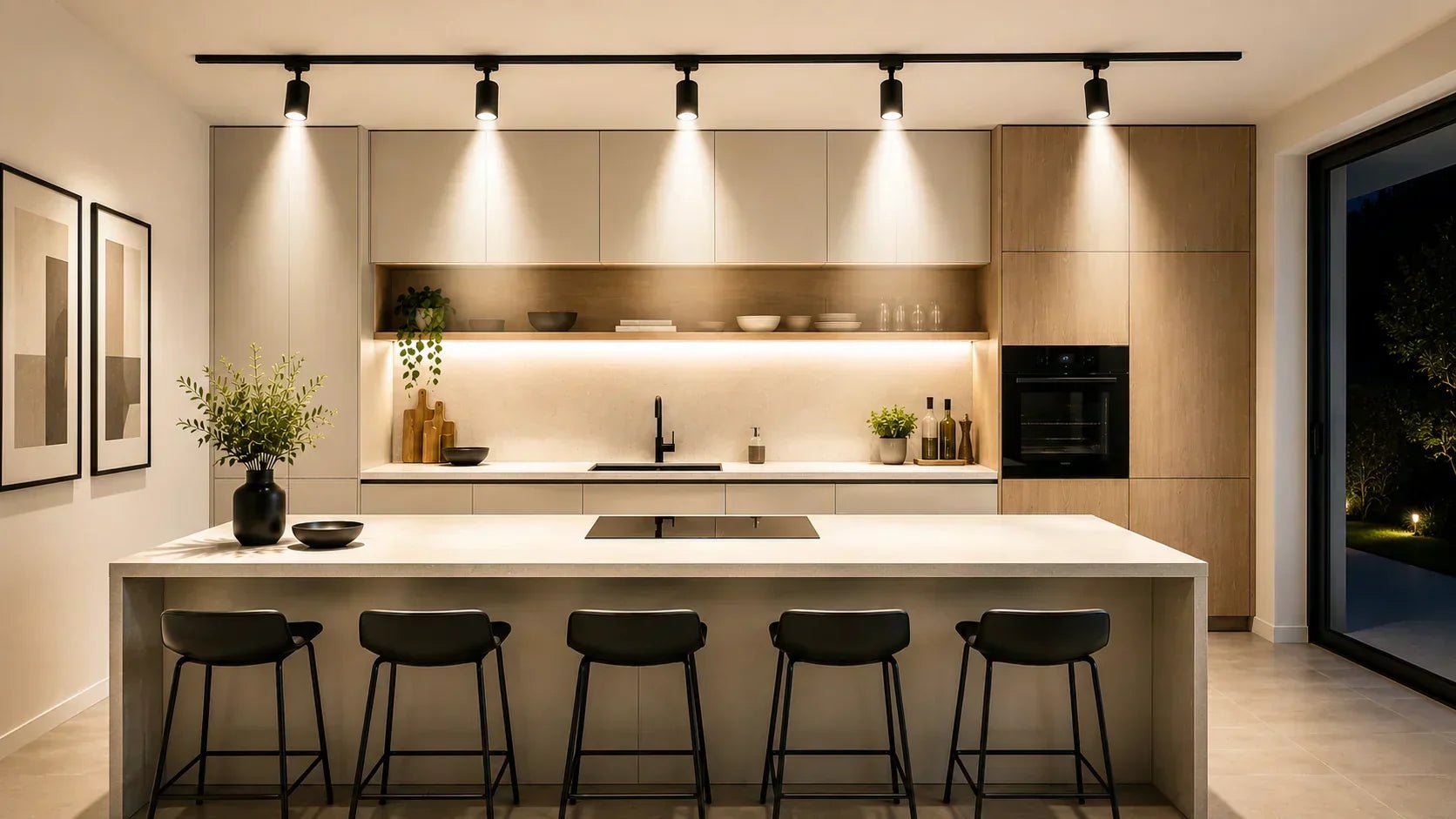
A single lamp on the ceiling – that’s a thing of the past. Anyone looking for flexible lighting today opts for a track system. Spotlights that can be moved, retrofitted, and look great, too. But how does it actually work – and what do you need for it?
What is a track system?
A track system consists of a metal track mounted to the ceiling and lights or spots that are attached to it. The great advantage: the spots can be moved, rotated, and realigned at any time – without any drilling or an electrician.
For example, if you redecorate or rearrange your furniture, you can simply move the lighting with it. This makes track systems especially popular in living rooms, kitchens, and over dining tables.
Single-phase or three-phase – what’s the difference?
Single-phase tracks are the simplest and most common option for private households. All spots on the track are connected to one circuit – meaning they all turn on and off at the same time. This version is affordable, easy to install, and perfectly sufficient for most living spaces.
Three-phase tracks offer more flexibility. They have three independent circuits on one track – which means you can switch or dim different spots separately. This allows you to light a reading nook, dining table, and sofa independently, for example. This version is better suited for larger rooms, offices, or more sophisticated lighting concepts.
Important: Single-phase and three-phase are not compatible!
This is one of the most common mistakes made when buying: Spots for single-phase tracks do not fit on three-phase tracks – and vice versa. Anyone looking to retrofit or expand an existing track must first check which system is installed. When in doubt, a look at the track itself or a quick call to an electrician will help.
If you don't have a track yet and are buying new, you should choose one system from the beginning and stick with it – then everything will fit together.
How do I recognize which system I have?
This is relatively easy to determine. On a single-phase track, only 2 to 3 wires are connected to the track. On a three-phase track, there are 6 to 9 wires. There is also a visual difference – three-phase tracks are slightly wider and more robust than single-phase ones.
What other types of track systems are there?
Cable systems work similarly to track systems, but instead of a fixed track, two tensioned steel cables are used. This appears lighter and more modern, but is only suitable for certain room situations – for example, in rooms with very high ceilings.
What do I need for a track system?
For a complete track system, you need several components. The track itself is available in various lengths – usually 1, 2, or 3 meters. Tracks can often be connected or shortened. It is important to pay attention to the maximum load capacity of the track – i.e., how many total watts can be connected.
The power connection can be made via a ceiling rose or come directly from the ceiling. There are also pendant suspensions if the track is not to be mounted directly to the ceiling. The spots or lights must match the track – always check when buying whether the spot is suitable for single-phase or three-phase tracks.
Which bulbs fit in track systems?
Most track spotlights use GU10 bulbs – this is the most common socket for spots and spotlights. GU10 lamps operate directly at 230 volts, do not require a transformer, and are available in many light colors and brightness levels. If you want dimmable spots, look for dimmable GU10 LEDs and a compatible dimmer when purchasing.
Which rooms are track systems suitable for?
Track systems are particularly flexible and fit many situations. Above the dining table, several spots can be aimed precisely at the table. In the living room, different areas such as a reading nook, sofa, and shelf can be lit separately. In the kitchen, tracks are well-suited over the work surface. They are also an elegant alternative to classic ceiling lights in the hallway or bedroom.
In short
A track system is the most flexible way to light a space – spots can be moved, retrofitted, and realigned whenever you want. For private households, a single-phase track with GU10 spots is usually the best choice. If you want more control, opt for the three-phase version. And if you are retrofitting: always check first which system is installed – because single-phase and three-phase are not compatible.
At Saasil, you will find track systems, cable systems, and matching accessories – for every room and every style.


