

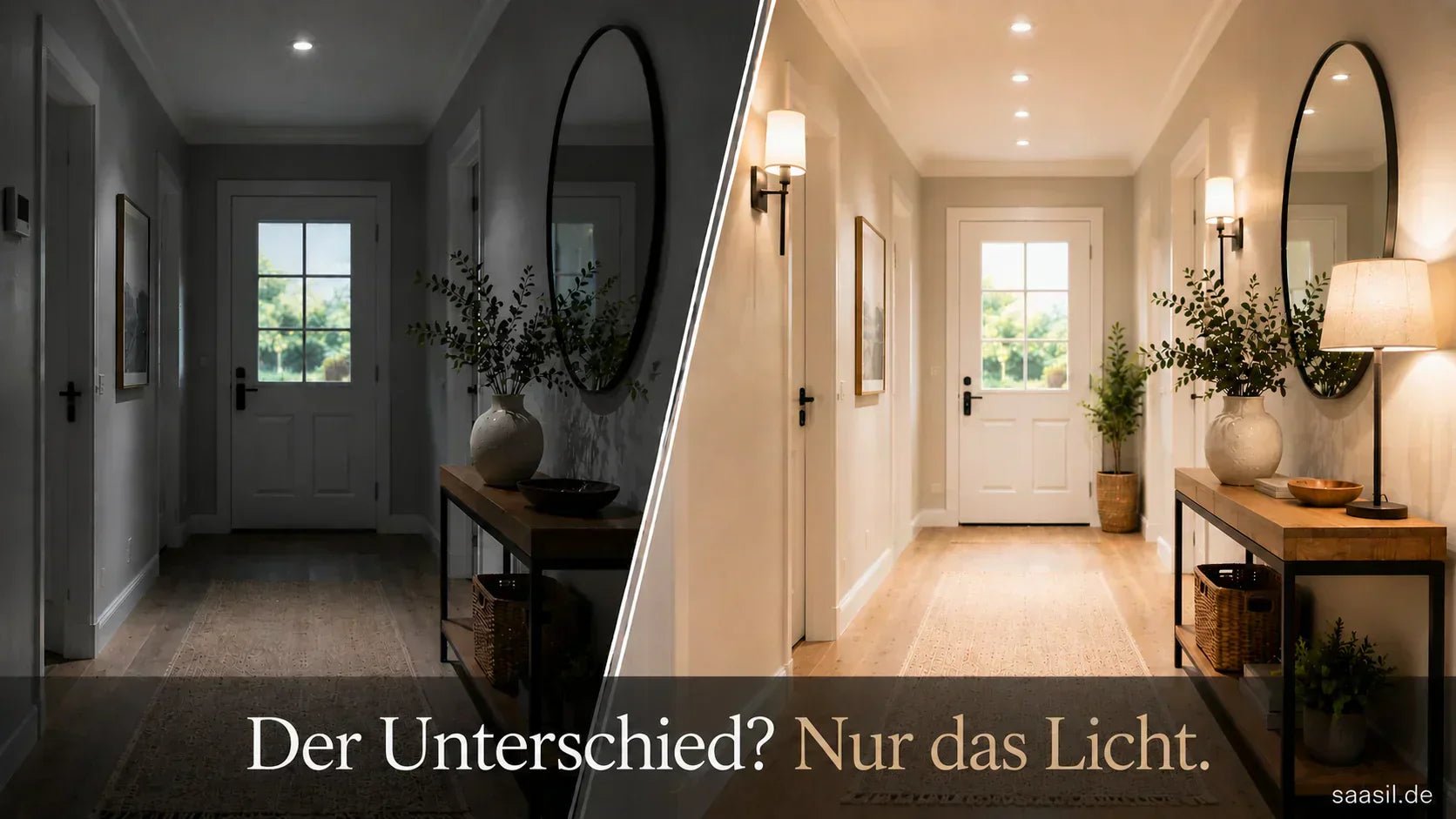
The hallway is often treated like a neglected stepchild. You walk through it, hang up your coat, change your shoes – and hardly give it a second thought. Yet, the hallway is the first room you enter when you come home. And the first room that guests see. Whether you feel welcome immediately or not – that is often decided by the lighting.
The special challenge: no daylight
Most hallways have one thing in common: no windows, or hardly any. This means that artificial lighting has to do all the work – at any time of day or night. If you cut corners here, you will permanently have a dark, uncomfortable passageway. If you do it right, you have a room that immediately says "home."
As a rule of thumb: at least 100 lumens per square meter. For dark walls, dark floors, or an especially long hallway, it is better to plan for a little more.
One light is usually not enough
A long or angular hallway can rarely be evenly illuminated with a single ceiling light. Dark zones are created – exactly where you hang up coats, look for shoes, or put down keys. The solution: multiple light sources at regular intervals.
If you only have a single ceiling connection, opt for a track system – it carries the light from the connection point in both directions and can be fitted with multiple spots. This way, even a long, narrow hallway becomes evenly bright.
Which light color suits the hallway?
In the hallway, the same applies as in the living room: warm white between 2700K and 3000K. This light feels inviting, friendly, and cozy. Cold light above 4000K makes the hallway look sterile – like a stairwell in an office building. That is not the feeling you want to have when you come home.
Narrow hallway – visually enlarge it with light
Many hallways are narrow and long – and therefore quickly feel cramped. Light can change that. A large mirror with side lighting makes the room feel larger immediately – it reflects the light and visually doubles the depth of the space. Wall lights that shine upwards and downwards draw the eye upwards and make low ceilings appear higher. And if you have a long hallway, place a point of light every few meters – this structures the space and gives it rhythm.
Mirrors and wall lights – more than just decoration
A mirror in the hallway with side lighting serves two functions: it makes the last check before leaving possible – and it makes the room appear visually larger. Especially in narrow hallways, this is a simple and effective trick.
Wall lights provide additional points of light and make the hallway feel more homely. They distribute the light on a different level than the ceiling light – this gives the room depth and makes it more inviting.
Accent lighting – small details, big impact
A well-lit hallway needs more than just basic lighting. Accent lighting highlights individual elements and turns the hallway into a real room instead of just a passage. A picture on the wall illuminated by a small spot. An illuminated wardrobe or hat rack. An LED strip under the shoe cabinet casting a soft glow on the floor. These are not major measures – but they make the difference between a hallway you rush through and one that lets you pause for a brief moment.
The first impression counts – even for yourself
People underestimate how much the light in the hallway influences their own mood. A bright, warm entrance area says "you are home" – a dark, bare passageway says nothing at all. This doesn't take much effort. Sometimes just one additional wall light or a targeted light accent is enough to turn a passageway into a real welcome area.
Discover our wall lights and ceiling lights for the hallway – the right solution for every floor plan.
Discover ceiling lights


