

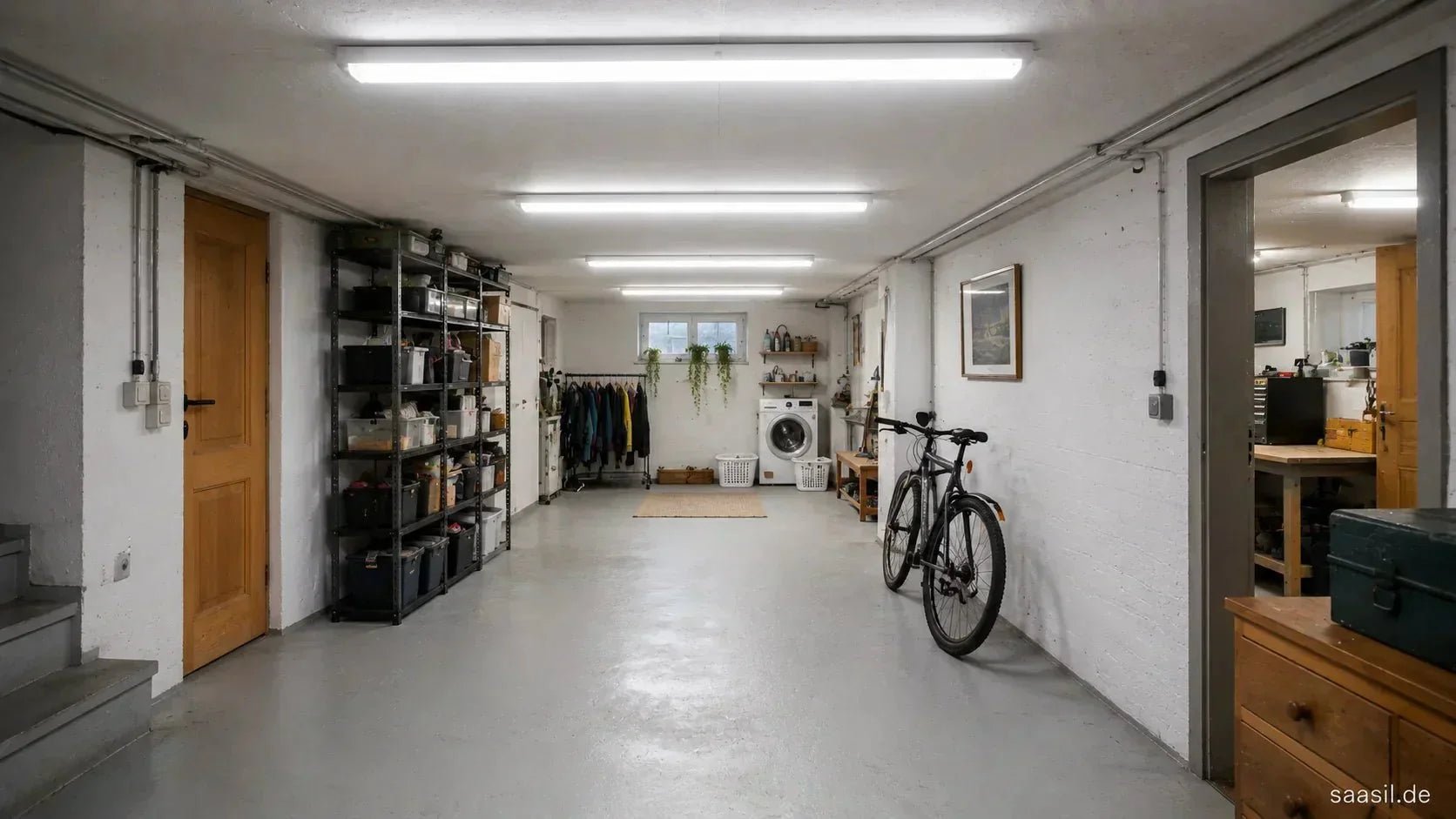
Garages and basements have different lighting requirements than living spaces. It’s not about atmosphere or coziness here – it’s about being able to see what you’re doing without hurting yourself, and ensuring the light fixture still works after years. Humidity, dust, and fluctuating temperatures quickly destroy standard indoor lights. Making the right choice makes all the difference.
The biggest problem: Humidity
Garages and basements are damp rooms – even if they don't look like it. Condensation, temperature fluctuations, splash water from washing the car, or damp basement walls mean that standard IP20 lights have no place here. They fog up from the inside, the base corrodes, and in the worst case, a short circuit occurs.
The solution is a damp-proof light – a fixture specifically built for such conditions. For garages and basements, at least IP44 is recommended. Anyone who occasionally uses a pressure washer in the garage or has an especially damp basement is better off choosing IP65 – dust-tight and protected against water jets.
Batten lights – the classic for garages and basements
The typical light for garages and basements is the batten light – an elongated fixture with a robust polycarbonate or metal housing and a clear cover. It is easy to install, provides uniform brightness, and is long-lasting. Batten lights are available with fluorescent tubes – the proven classic that works reliably even in the cold – or as a modern LED variant that consumes even less power and lasts even longer.
For a standard garage of about 20 square meters, two 36-watt batten lights are sufficient for uniform basic lighting. Anyone who also works in the garage is better off planning for three to four lights – shadow-free and bright enough for tool work.
How much light does the garage need?
As a rule of thumb: at least 300 lumens per square meter for a normal garage. If you work in the garage – whether on the car, at the workbench, or on DIY projects – you need 500 lumens per square meter or more. That sounds like a lot, but anyone who has ever lain under a car and couldn't see what they were wrenching on knows why.
For the basement, 200 to 300 lumens per square meter are usually sufficient – depending on whether you are just storing things or actually working.
Light color – not too warm, not too cold
For garages and basements, we recommend neutral white light between 4000K and 5000K. Warm white light creates a cozy feel – but in the garage, you don’t want a cozy atmosphere; you want to see if the brake disc is still in good condition. Neutral white light shows colors and details most naturally and helps with all manual tasks.
What to do when it gets cold?
A frequently overlooked problem: Many LED lights start poorly or flicker at temperatures below 0 degrees. If you have an unheated garage, check that the light is suitable for a temperature range down to -20°C when buying. Classic fluorescent tubes are often more robust here than cheap LED alternatives – they ignite reliably even when it’s freezing outside.
More than just light on the ceiling
Anyone doing more than just storing things in the garage or basement should also think about supplementary lighting at the workbench. A bright under-cabinet light or an adjustable spotlight directly above the work area makes precise work much more pleasant. Ceiling light alone is rarely enough here – you are always standing in your own shadow.
Take a look at our damp-proof and batten lights – robust, durable, and suitable for every garage and every basement.
Go to Basement Collection


