

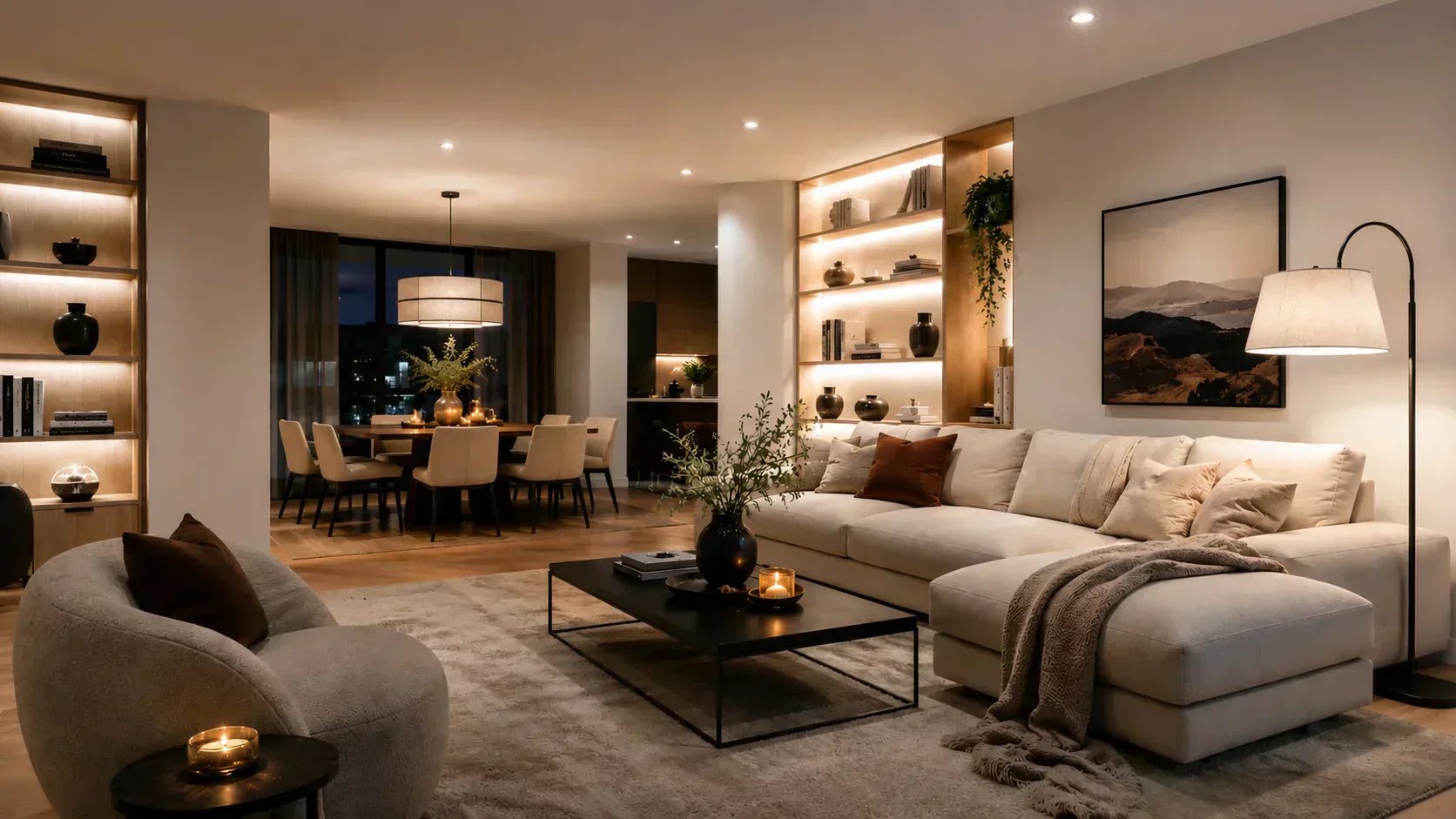
The living room is the space where you relax, host friends, watch movies, and sometimes read or work. All of this in one room – and a single ceiling light is supposed to cover it all? That cannot work. If you want your living room to be truly cozy, you need a lighting concept consisting of several layers.
First the basis: even light for the whole room
General lighting ensures that the entire room is evenly lit – without dark corners and without blinding islands of light. As a rule of thumb: 100 lumens per square meter is more than enough for the living room.
Which light fits best often depends on a small detail that many overlook: Where is the power connection on the ceiling? If it is in the middle of the room, a pendant light or ceiling light is the most obvious choice. If it is to the side or in a corner – which is the case in many older apartments – then a single light is not a good idea. This is where track systems come into play: They guide the light from the connection in all directions and can be flexibly equipped. This way, even an inconveniently located power connection is no longer a problem.
One more note on choosing the shade: A pendant light with a translucent glass or fabric shade distributes light evenly throughout the room. A light with an opaque shade made of concrete or dark wood only casts its light downwards – that can look nice, but usually isn't enough as general lighting.
Then the zones: light where you really need it
The living room rarely has only one function. The reading corner needs different light than the dining table, and the sofa needs different light than the bookshelf.
Imagine sitting in your favorite corner with a book in the evening. The ceiling light is on – but the light comes from above, casts shadows on the pages, and after an hour, your eyes start to burn. A floor lamp or wall lamp right next to the reading area changes that immediately. The light comes from the side, doesn't glare, and makes reading a pleasure. For focused reading, neutral white light of around 3000K to 3500K is recommended – it keeps you more alert than warm light.
For the dining table or coffee table, pendant lights with opaque shades are ideal – they cast their light in a cone shape downwards and highlight exactly the area where you are sitting together. All other areas remain pleasantly dimmed – this creates intimacy without anyone sitting in the dark.
Finally, the special touch: light that sets the mood
Accent lighting is what makes a room truly special. It has no functional task – it creates atmosphere. A picture on the wall illuminated by a small lamp. A shelf indirectly lit from below. Or – a tip many underestimate – an LED strip behind the TV.
That sounds like a gimmick, but it is actually practical: When the room is dark and the screen is glowing brightly, a strong contrast is created that tires the eyes. A warm LED strip behind the TV balances out this contrast – your eyes relax, and your movie night becomes more pleasant. And incidentally, it also looks good.
Indirect lighting behind furniture, sideboards, or under the sofa works similarly: The light itself is not visible – only its glow on the wall or floor. This makes rooms feel larger, warmer, and softer – in a way that you feel immediately but is hard to explain.
Which light color fits in the living room?
The answer is clear: warm white between 2700K and 3000K. This light resembles the traditional light bulb – it feels cozy, relaxing, and homely. For the reading corner or if you are still working focused in the evening, it can be a bit more neutral – around 3000K to 3500K.
What you should avoid in the living room: cold, blue-tinted light over 4000K. This looks sterile and exhausting – and belongs more in an office or kitchen.
Which bulbs for the living room?
LED – no ifs or buts. Not because it sounds modern, but because it is simply the better choice. LED lamps consume up to 80% less electricity than old halogen lamps, hardly heat up, last years longer, and are now available in every light color and brightness. The days when LED light was cold and unpleasant are long gone.
If you want maximum flexibility, look for bulbs labeled "tunable white" – this allows the light color to be adjusted according to mood and time of day. Cooler and clearer in the morning, warm and cozy in the evening – all with the same lamp.
Dimming – not optional, but necessary
A living room without dimmable lights is only half a living room. Bright and clear in the morning, warm and dimmed in the evening – the mood changes, and the lighting should adapt to it. Anyone who has once lived with dimmable lights never wants to be without them again.
Important when buying: Not every LED lamp is dimmable. The packaging must explicitly state "dimmable" – and the dimmer must be suitable for LED. You can find everything on this in our article about dimmable light sources.
The right light makes all the difference
Three steps, one goal: a living room where you truly feel at home. Basis, zones, atmosphere – if you keep this order in mind, you can't go wrong when buying. The rest is a matter of taste. But the foundation is solid.
Check out our lights for the living room – from ceiling lights to small accent lights, we have it all.
Discover floor lamps


