

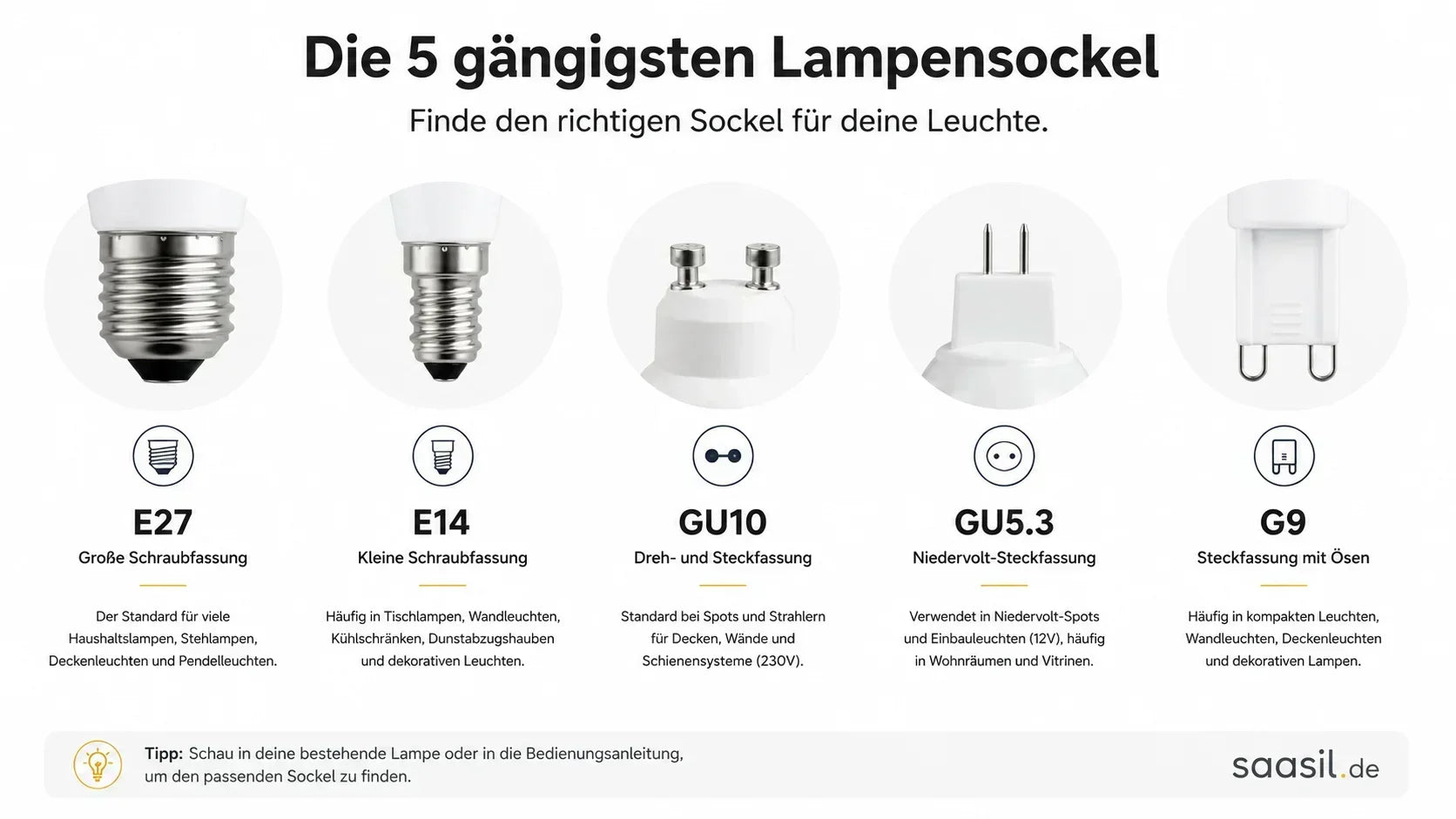
E27, E14, GU10 or GU5.3 – which base do I actually need? The designations look complicated at first. However, if you know what to look for, the right connection can usually be identified quickly. The only important thing is: A matching base alone is not enough. The voltage, dimensions, and, if applicable, the dimmer or transformer must also be compatible with the light source and the light fixture.
Base or socket – what is the difference?
In everyday life, many people talk about an E27 or GU10 "socket" (Fassung). Technically speaking, however, the socket and the base (Sockel) are two different components:
The socket (Fassung) is located in the light fixture. It receives the light source, holds it in place, and establishes the electrical contact.
The base (Sockel) is located on the replaceable light source. It is the matching counterpart to the socket.
When you buy a new light source, you are, for example, looking for a light source with an E27 base for an E27 socket. A ring mount on a lampshade should be distinguished from this: it serves to attach the shade and is not the base of the light source.
What do the letters and numbers mean?
The first letter describes the basic design. E stands for the Edison screw thread. G denotes bases with protruding contacts, for example, pins or loops.
The number does not represent the same measurement for every base. For E14 and E27, it refers roughly to the thread diameter in millimeters. For two-pin G-systems like GU10, GU5.3, or G4, it describes approximately the distance between the centers of the contacts.
Additional letters are also important. G4 and GU4 or G6.35 and GY6.35 should not be treated as identical simply because of the same numerical value. Therefore, always compare the complete base designation.
Operating voltage is not part of these basic designations. Therefore, GU10 does not automatically mean 230 volts, and GU5.3 does not automatically mean 12 volts. The decisive factors are always the specifications on the specific light source, the light fixture, and, if applicable, the existing control gear.
The most important bases in comparison
| Base | Connection | Meaning of the number | Check especially |
|---|---|---|---|
| E27 | Screw thread | approx. 27 mm thread diameter | Voltage, wattage, dimensions, brightness, light color, dimmability |
| E14 | Screw thread | approx. 14 mm thread diameter | same as E27; E14 and E27 are not directly interchangeable |
| GU10 | Twist-and-lock system | approx. 10 mm contact distance | Voltage, dimensions, beam angle, dimmability |
| GU5.3 | Two straight pins | approx. 5.3 mm contact distance | Voltage, transformer/control gear, dimensions, dimmer |
| G9 | Two loop contacts | approx. 9 mm contact distance | Voltage, length, diameter, dimmability |
| G4 / G6.35 / GY6.35 | Two straight pins | approx. 4 or 6.35 mm contact distance | Complete identification, voltage, dimensions, control gear |
| R7s | Double-ended rod lamp | The base code does not determine lamp length. | Especially length, diameter, and dimmer compatibility |
E27 and E14: the screw bases
E27 and E14 both use an Edison screw thread but have different sizes. An E14 light source cannot be screwed directly into an E27 socket – and vice versa.
Both bases are available in various bulb, candle, and decorative shapes. Therefore, the same base does not automatically mean the same external dimensions, brightness, or light color. Before purchasing, also check the actual power consumption of the new light source. A label such as "equivalent to 60 W" describes the comparable brightness of an older lamp and is not to be equated with the actual power consumption of the LED.
Have you already found the designation? Then you can compare E27 light sources or E14 light sources.
GU10: insert and twist
GU10 has two short contacts and is locked in the socket by inserting and twisting. The number 10 stands approximately for the distance between the centers of the contacts – not for the diameter of the socket.
GU10 is frequently used for spots and directional reflector lamps. Many current GU10 retrofit products for the European market are designed for 220–240 volts. Nevertheless, you should always check the voltage specification on the specific product and on the light fixture.
For spots, the beam angle is also important: a narrow angle focuses the light more strongly, while a wide angle distributes it over a larger area. You can find suitable models in our selection of GU10 light sources.
GU5.3 and MR16 are not the same
GU5.3 refers to the base. MR16 describes the reflector shape or size class. Many MR16 light sources have a GU5.3 base, which is why both specifications often appear together on the packaging. They are nevertheless not synonyms.
Many commercially available GU5.3/MR16 light sources operate on 12 volts. However, the base code itself does not determine this voltage. If you have an existing low-voltage system, you must therefore check the output voltage and the manufacturer's specifications for the light source.
For LEDs, it is also crucial whether the new light source is compatible with the existing transformer or electronic control gear. A mechanically compatible base may still be electrically unsuitable. The same applies to dimmers: "dimmable" does not automatically mean "compatible with every dimmer."
If your old light source is clearly marked with GU5.3, you can view suitable GU5.3 light sources and then compare voltage, dimensions, and system compatibility.
G9, G4, G6.35 and GY6.35
You can recognize G9 by two characteristic loop contacts. The light source is inserted straight and not twisted like a GU10. Especially with small lamp shades, you should check the total length and diameter in addition to the voltage, because G9 LEDs and G9 halogen lamps can be different sizes despite having the same base. You can find our G9 light sources here.
G4, G6.35, and GY6.35 belong to the pin base category. Many corresponding products are used in low-voltage systems. Nevertheless, the voltage must always be checked separately.
Pay special attention to additional letters: G4 and GU4 as well as G6.35 and GY6.35 are complete, different base designations. Do not order based solely on the measured contact distance; instead, compare the entire identification of the old and new light sources. You can find our current selection among the G4 and 6.35 mm pin base lamps.
R7s: The exact length is decisive
R7s is used for linear, double-ended rod lamps. However, the designation R7s alone is not sufficient for selection. You must absolutely compare the total length – common sizes are, for example, 78 or 118 mm – and check whether the diameter and design fit into the light fixture.
An R7s LED may have different external dimensions than a classic R7s halogen lamp. Dimmer suitability is also a separate product feature. Therefore, do not just compare the base before choosing an R7s light source.
How to find the right light source
- Switch off the light: For a portable table or floor lamp, also pull the power plug and let the light source cool down completely.
- Read the designation: Look for details such as E27, GU10, GU5.3, G9, or R7s on the old light source.
- Check light data: Check the type plate, sticker, or instruction manual for voltage, maximum permissible wattage, and other specifications.
- Compare dimensions: Check the total length, diameter, and the available space in the glass, shade, or lamp housing.
- Select light: Compare lumens for brightness, Kelvin for light color, and, if required, CRI/Ra for color rendering.
- Clarify system compatibility: With a dimmer or low-voltage system, the dimmer, transformer, or control gear must also be compatible with the specific LED light source.
If the label is no longer legible, take a photo of the old light source, its base, and the switched-off, empty socket. The manufacturer's name, article number, or EAN/GTIN usually help with identification more than a comparison based solely on appearance.
Change safely – without working on the electrical system
This guide refers exclusively to the replacement of a replaceable light source intended for this purpose. Do not use force when removing or inserting it and do not perform measurements on live parts.
Sockets, wires, terminals, or other electrical connections must not be altered. If the socket is loose, broken, discolored, or charred, do not continue using the lamp and have it professionally checked. For halogen light sources, additionally observe the manufacturer's handling instructions.
Summarized briefly
- Read the full base designation including additional letters.
- Do not infer voltage solely from the base name.
- Compare length, diameter, and available installation space.
- For low voltage and dimming, also check the transformer, control gear, and dimmer.
- Do not experiment if unsure; instead, compare product data, EAN, and photos.
Frequently asked questions
How do I know which base I need?
Switch off the light, let the old light source cool down, and read the complete base designation on it. Additionally, check the type plate or manual of the lamp. If in doubt, photos, manufacturer name, article number, or EAN/GTIN will help.
Can I replace GU10 with GU5.3?
No, not as a simple light source change. The bases have different contact spacings and connection types. Furthermore, the voltage and, if applicable, the existing control gear must be compatible with the specific light source.
Is GU5.3 the same as MR16?
No. GU5.3 refers to the base, MR16 to the reflector shape or size class. Both specifications often appear together on a product but do not mean the same thing.
Can I use E14 instead of E27?
Not directly. Both use an Edison screw thread but have different standardized sizes and each requires the appropriate socket.
Why does a light source not fit despite having the same base?
The base does not describe the overall external dimensions. Length, diameter, or reflector shape may vary. Additionally, voltage, dimmer, or transformer/control gear may be incompatible.
Can every LED light source be dimmed?
No. The light source must be explicitly marked as dimmable. Additionally, it must be compatible with the existing dimmer and, in the case of low-voltage systems, possibly with the control gear.
Do you now know the base of your light fixture? Before buying, check the voltage, dimensions, and – if present – the dimmer or transformer/control gear.
Discover suitable light sources at Saasil


