

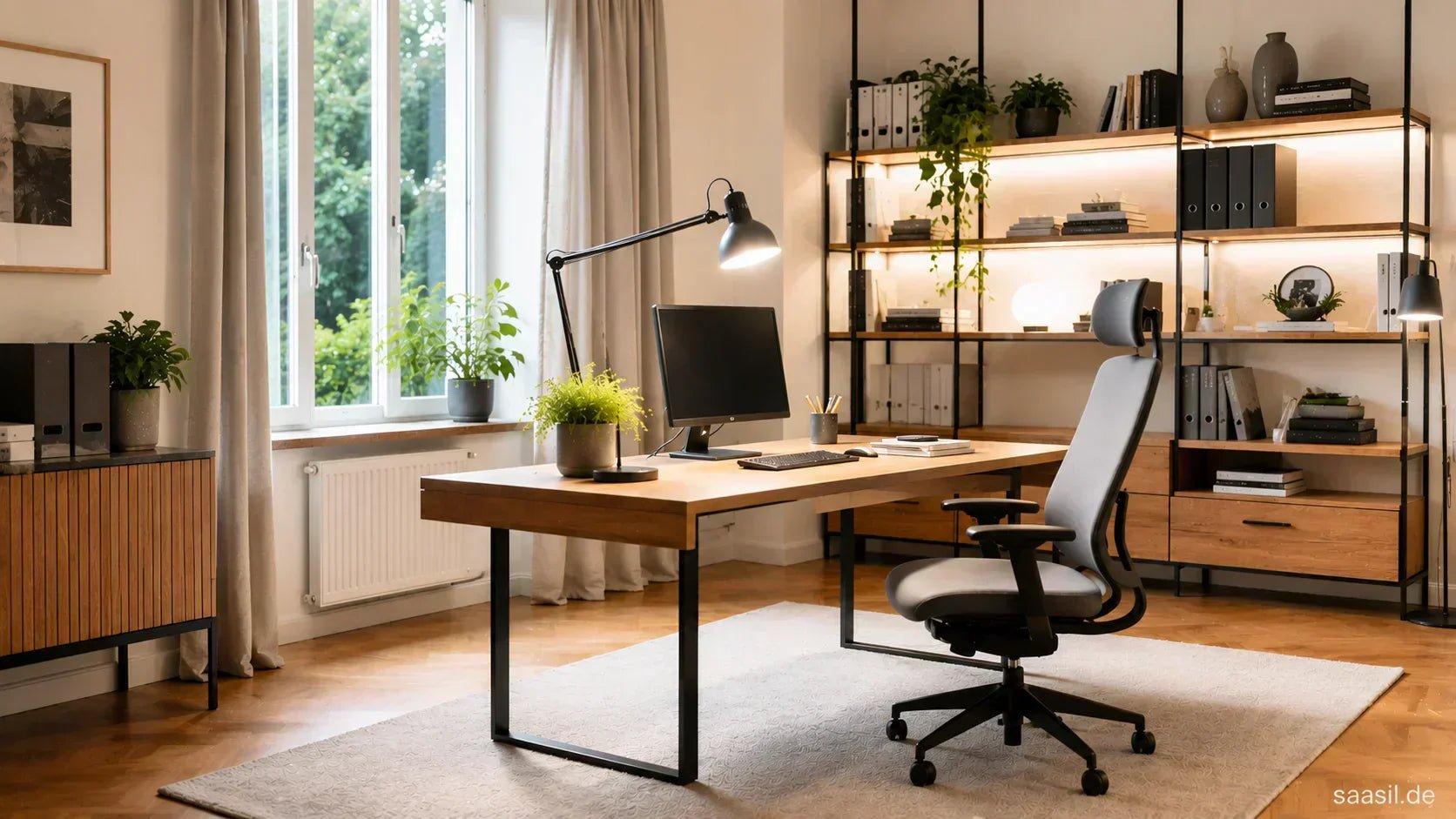
It’s 5 PM. The workday is officially over. Your eyes are tired, your head feels heavy, and all you crave is fresh air and natural daylight. Yet, you haven't even worked that hard. Often, the cause isn't the workload – but the lighting: too dark, too warm, or poorly positioned. The result is faster eye fatigue and waning concentration. And yet, it would be surprisingly easy to change that.
Daylight first – artificial light as a supplement
The best light for a home office costs nothing: natural daylight. It boosts concentration, promotes well-being, and keeps you alert – better than any artificial light source. Your desk should therefore be as close to a window as possible, ideally at a 90-degree angle to the window – not directly in front of or behind it. In front means glare from the window, behind means shadows on your workspace.
When daylight fades – in the evening, in winter, or on cloudy days – artificial lighting takes over. And this is where most mistakes begin.
At the desk: bright, glare-free, and from the right side
Your desk needs at least 500 lux – that is significantly more than in the living room. A single ceiling light is almost never enough because the light source is too far away and casts too many shadows. The solution is a desk lamp right at your workspace.
And here is a simple trick most people don't know: right-handed people should place the lamp on the left, left-handed people on the right. This way, the light falls onto the workspace from the correct side, and your hand doesn't cast a shadow on the paper or keyboard. The light should come from slightly to the side and front – never directly from above or behind.
Which light color for the home office?
There is a clear rule for the home office: neutral white to cool white between 4000K and 5000K. This light keeps you alert, promotes concentration, and makes colors appear natural. Warm white light below 3000K is meant for the kitchen or bedroom – in a home office, it makes you tired.
A practical tip: those who buy a lamp with adjustable color temperature have the greatest flexibility. Cooler and brighter during the day for concentrated work, warmer and dimmed in the evening when you are still on your laptop but want to start winding down.
Avoiding glare – the most common mistake
Glare is not just caused by light that is too bright – it is caused by contrast. Looking at a bright screen in a dark room strains the eyes just as much as looking directly into a lamp. The solution: the ambient room lighting should always be on when you work – not just the desk lamp.
The screen itself also plays a role. Light fixtures should not be behind the monitor and reflecting in it. The side is always better than directly from the front or back.
Indirect lighting – underestimated but effective
A well-lit home office doesn't just need desk light. Indirect lighting – a floor lamp that shines upwards, an LED strip behind the monitor, or wall lighting – provides uniform ambient brightness without harsh shadows. This noticeably relieves eye strain, as the contrast between the screen and the surroundings is reduced.
Those who see well, work better
Good light in the home office is not a matter of taste – it is a matter of health. Bright, neutral light from the right side, without glare and with sufficient ambient light in the room. Once you have set this up correctly, you will immediately notice the difference – fewer headaches, less tired eyes, and more energy at the end of the day.
Discover our desk lamps and ceiling lights for the home office – the right solution for every workspace.
Discover ceiling lights


